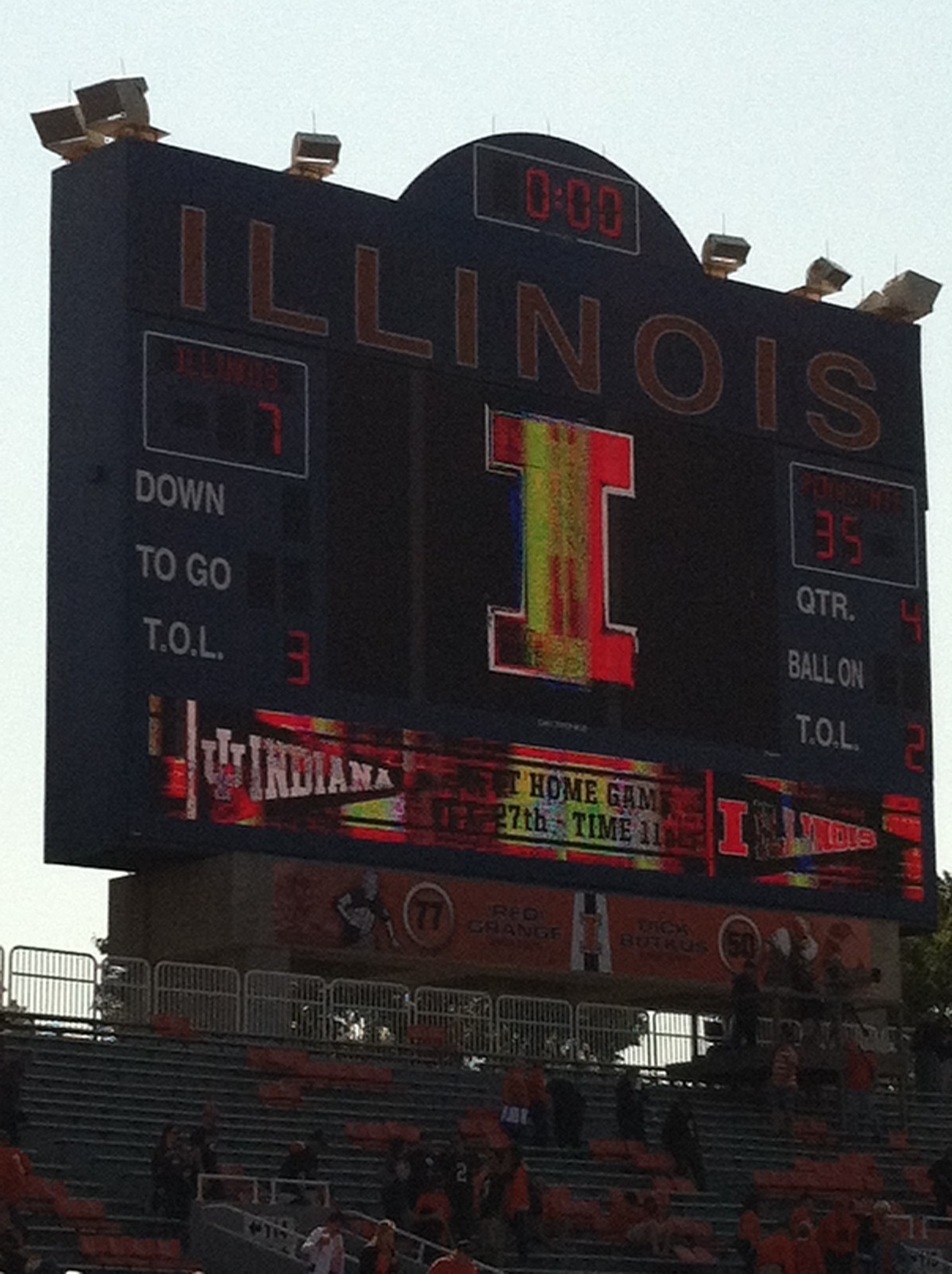
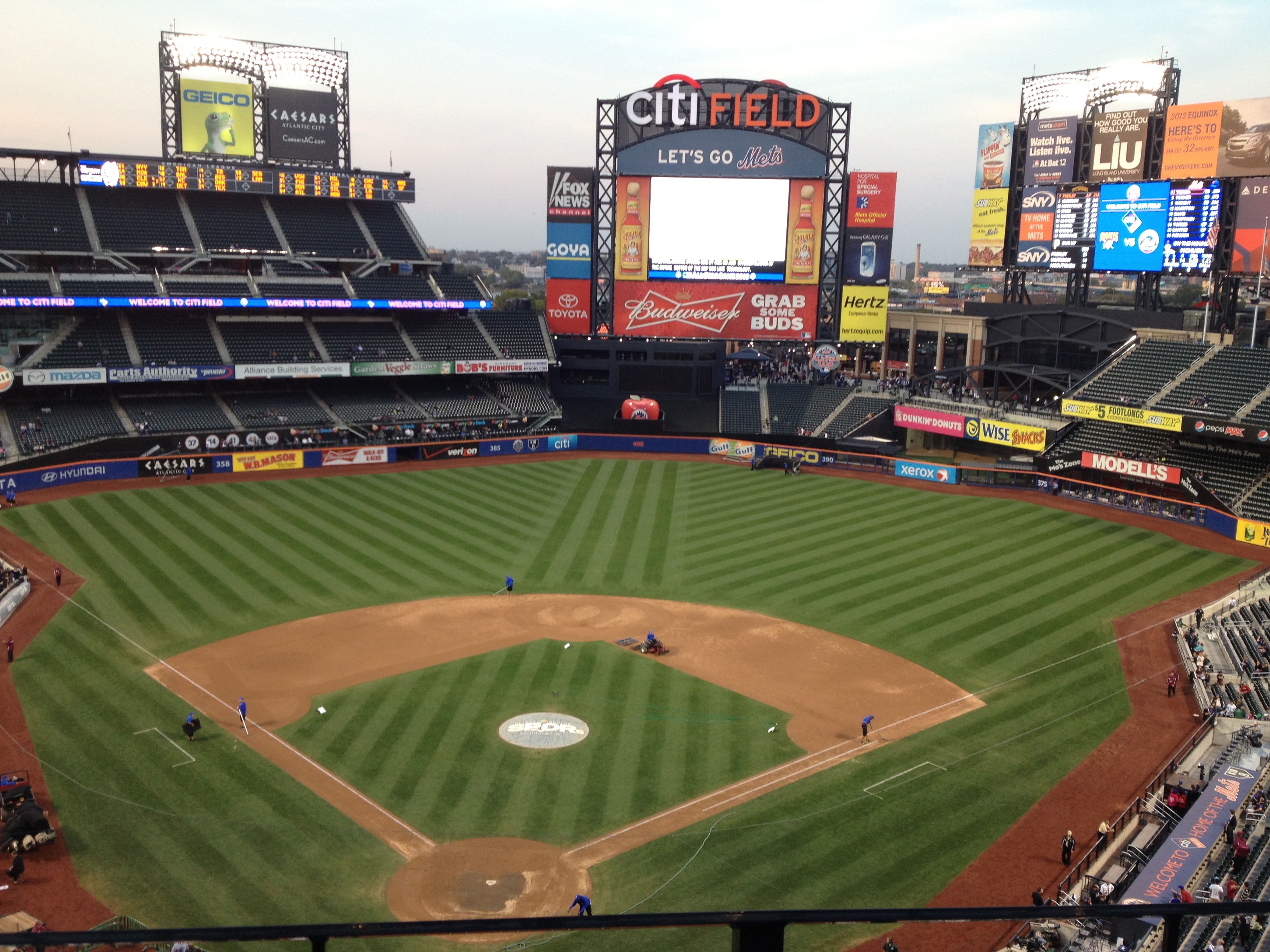
SOLO IN ENEMY TERRITORY PROJECT PART 2: PENN STATE VS. ILLINOIS

By Pat Combs

Driving across Indiana lends itself well to thinking. There’s not a lot out there to distract a driver; this shouldn’t surprise anyone.

 http://www.gourmet.com/images/gmtlive/2012/100312/impact-of-2012-drought_608.jpg

( I didn’t actually take the above picture, but you get the point.)

I drove from my place in Lafayette across the border to Champaign, Ill., last Saturday to see my first Penn State football game in nearly two years.  I hadn’t seen the Nittany Lions play in person since they beat Michigan in 2010.

It’s safe to say that things have changed since then.

That’s primarily what filled my mind as I made my way through metropolises like Wingate and Veedersburg.  As Pete’s story from earlier this week mentioned, he and I each took in a game – or, in his case, games – in “enemy” territory.  It’s always been a dream of mine to see as many different college football stadiums as possible, so at least Memorial Stadium could be checked off the list.

You’ll notice that I omit words like “hostile” from this piece.  There’s a reason for that – Memorial Stadium and its fans couldn’t have been any more welcoming.  Naturally, I was concerned about how Illinois fans would treat opposing fans (namely, me) of an embattled team, but Illini fans were extremely benign.

Almost sleepy.

The worst I saw was a woman sitting in front of me who constantly complained about her team’s play during the game, but she’s an Illinois football fan – how much could she expect?  There was also a couple sitting a few rows behind me who seemed like they were straight out of a terrible football-themed comedy.  The man yelled “BLITZ!!!” before every play of the first half.  Every.  Play.  His wife yelled “TOUCHDOWNS!!!” only slightly less frequently (her use of the plural form of the word went for naught; Illinois scored just seven points).  Other than observing their knowledge of two football words, they seemed to know nothing of the game.

The positive experiences far outnumbered the minor annoyances of BLITZ and TOUCHDOWNS.  To start with, I had a terrific seat.  A woman and her son had an extra ticket and sold it to me for a very reasonable price.  I had gone to the game without tickets, figuring I’d gamble an hour-and-a-half drive rather than pay $50 to see Illinois football (would you?).  I spent some time in the Penn State alumni tent and had a pretty good time…seven minutes in, I’d already secured a free Rice Krispies treat and orange juice.  Big Ten football demands hearty breakfasts.

Not a bad view for $20.

While in the tent, I saw an older Penn State fan named Walter.  I did not discuss the game with Walter, nor did I even talk to him.  I didn’t even introduce myself to him.  How did I know Walter’s identity?  He was wearing a knitted sweater that had to have been 30 years old with his name emblazoned down the sleeve.  If I weren’t a grad student living on a stipend, I would’ve offered him at least $40 for it.  Sadly, the lighting in the tent combined with the obvious creepiness of taking a cell phone picture of an old guy’s arm prevented me from obtaining photographic evidence.

Everyone in Champaign (and Urbana, technically the city in which I parked) was beyond friendly.  Even the Illini band waved to and cheered for the Blue Band.  The parking attendant who took my money wished me luck and told me that the parking lot was full of mostly Penn State fans (she was right).  As I walked into Memorial Stadium, I passed a guy selling programs who was more than accommodating with his sales pitch:

“Yinz wanna buy a program?”

Yes, even the fine people of central Illinois are at least proficient in Pittsburghese.  One woman responded that she felt at home.

Memorial Stadium itself is a venue more notable for its architecture and history than its atmosphere.  It’s a stadium that held many games in which the Illini were led by Red Grange and displays its age well.  It would probably be a pretty cool scene should its inhabitants begin holding more meaningful games; I think the fans would be there to provide a strong environment if the stakes were higher than in the current post-Zook era.  The stadium has 200 columns ringing its exterior, giving it a pretty cool look.  Inside, large banners hung from the rafters display famous former players such as Grange, Dick Butkus and former Steelers legend Matt Cushing.  It occurred to me that I was inside the stadium where my favorite Penn State player of all-time, Brian Milne, scored the biggest touchdown of his career to cap one of the great drives in Nittany Lion history.

The external walls of Memorial Stadium.

The game itself was a successful one for myself and other Penn State fans, but my time on the inside of Memorial Stadium wasn’t all that eventful.  Aside from a convincing 35-7 Penn State win and the several perplexing chants of “OSKEE-WOW-WOW,” it was actually a pretty dull game.

In some ways, my excursion to Illinois was a bit disappointing.  I went to a college football game – a Division I football game!  A Big Ten football game! – completely devoid of animosity or even mild fan-inspired intensity.  I obviously didn’t want to hear anything disrespectful directed at Penn State fans, but I was looking forward to at least some football-related chiding from the home fans.  I wanted competitive banter.  I wanted some jawing back and forth.  I wanted just a little well-placed, football-specific vitriol.

I found none.

But as a Penn State fan traveling to a foreign stadium, I know how fortunate this situation was.  The Illinois fans I encountered were nothing short of classy and I heard not one word from an Illini faithful regarding the events of the past 11 months.  Of course, I’m glad I didn’t, because, for at least a few hours, football was about football, even for Illinois fans.

Now all they need to do is have their offense work on making TOUCHDOWN plural.

The proof of Penn State’s dominant performance.


— Pat Combs is a contributing writer for the Keystone Sports Spot. He is a Penn State alum and current Purdue grad student.


SOLO IN ENEMY TERRITORY PROJECT PART 1: PIRATES VS. METS

I remember the first thing I looked for when the Pittsburgh Pirates’ 2012 season schedule was released.

I was sitting on my bed in my small but adequate Brooklyn apartment. On the walls around me hung a No. 14 Wally Richardson Penn State jersey, a No. 39 Willie Parker Steelers jersey and a No. 58 Jack Lambert Steelers jersey. And hanging on the wall at the foot of my bed was my Pirates jersey, the last thing I saw every night before I fell asleep.

As I scanned the schedule, I looked for any games the Pirates would have against either the Yankees or the Mets. I’d be able to watch all of those games, home or away, on my local television channels. It’s far more enjoyable to watch baseball on my 36-inch TV than using MLB.TV on my tiny laptop screen. But more importantly than the television schedule, I wanted to know if the Pirates were coming to New York City.

I’ve lived in New York for more than two years now and that means I’ve had to battle the distance between here and Pittsburgh. I grew up about two hours away from the Steel City so it was relatively easy to go to a Pirates, Steelers or Penguins game (and they were all on local TV to boot). But in New York, I have to work around that. I subscribe to MLB.TV. I purchase NHL Game Center. I have DirecTV’s NFL Sunday Ticket. None of these subscriptions is cheap, but that’s the price I pay for fanhood.

I saw that the Pirates had three-game series in against the Mets in late May, but it was in Pittsburgh. That meant that the Buccos would be heading the Queens later in the season. So I continued to scroll through the schedule until I hit September. There I found the series I was looking for: four games against the Mets at Citi Field from the 24th to the 27th.

The late-season series meant two things. If one or both of the teams were somehow in playoff contention at that point, then it would be a more expensive ticket. But that would also mean seeing a contending team or two close to the playoffs and it could have serious implications. Fun.

But the more likely scenario would mean that both teams were way out of playoff contention by then (not fun), but tickets would be dirt cheap. The previous season, a friend and I went to a Pirates/Mets game at Citi Field in September. The combined cost of the tickets was $4.

Regardless of the scenario, I was going.

The entire 2012 season was in preparation of this series for me, and by the time July rolled around, I believed I would be going to see the first Pirates team in 19 years to finish as winners. I worried that the tickets might gut my wallet, but money was no issue when it came to my teams.

On Sunday, Sept. 23, I went online to find tickets for my long-awaited series. Surprise, surprise, the cheap seats were single digits. This was the product of an epic collapse, the second of the kind in two years for the Pirates. They were 75-77, 6 1/2 games back of the National League wild card, 16 1/2 games back of the division leading Reds and the Buccos needed to win seven of their final 10 games to finish with a winning season.

The Mets were in even worse shape than the Pirates. They were 69-83, 12 1/2 games back of the wild card and 23 games back of the division lead.

These were two pathetic teams butting heads in September. This series couldn’t be about dignity for the Mets, they had lost that long ago. This series was about finishing strong for their fans at home. This was also a chance for David Wright to become the Mets all-time hits leader (he was only a handful away and would face a crumbling Pirates rotation).

For the Pirates (if they were optimists), this was about creeping above .500 against a team who had no such chance. But from the looks of them, the Pirates are not a team of optimists and even with a sweep of the Mets, they hardly stood a chance in winning three more games against the division leading Reds and the No. 1 wild card Braves.

I decided to go to three of the four games. Four would have been nice, but I was still suffering the effects of a heavy football weekend and Monday didn’t seem like an ideal time to schlep myself through three subway lines and two transfers. I convinced a friend to accompany me to the Thursday day game (which wasn’t that difficult considering she was a Mets fan and that was the day R.A. Dickey would go for his 20th win), but I would go the Tuesday and Wednesday night contests alone. Here’s what the first two tickets cost me:

Pittsburgh Pirates at New York Mets at Citi Field, Flushing, NY

Tue, 09/25/2012, 7:10 p.m. EDT

Promenade Infield 513 | 1 ticket

Row 2 | Seat 9

Billing review

Price per ticket: $10.00

Quantity: x 1

Subtotal: $10.00

Service fee: + $5.00

Delivery services: + $5.45

Order total: $20.45


Pittsburgh Pirates at New York Mets at Citi Field, Flushing, NY

Wed, 09/26/2012, 7:10 p.m. EDT

Promenade Outfield 535 | 1 ticket

Row 1 | Seat 5

Comments: Actual 1st row of section

Billing review

Price per ticket: $2.59

Quantity: x 1

Subtotal: $2.59

Service fee: + $5.00

Delivery services: + $5.45

Order total: $13.04


The grand total cost me $33.49. That’s an average of $16.74 per game. The games would probably leave much to be desired but I believe it’s a fair price to pay for a nice night at a pro ball park.

 Disclaimer: For the purposes of this blog, I am documenting only the first two games of the three I went to. These were the only times in my life I’ve attended any away Pirates games alone and those are the experiences I wish to explore and share.

Before I went to the games, I decided to pick a different style of how I would experience each game. For the Tuesday game, I’d simply take in the fan experience as most do. I’d show up early, find my seat and buy a Nathan’s hotdog and a Budweiser. I wanted to feel the game rather than watch it. I wasn’t going to pay strict attention to the details of the game like a stat geek. I wouldn’t keep score and I’d just have fun with it. I wanted to converse with some other fans and take note of how it all felt. How was the atmosphere? Were there very many people there? Did anyone care that I was decked out in Pirates gear? I wanted the big picture of how I felt to be at the ball park without the soul focus being on balls, strikes and keeping track of the relievers’ strike totals.

For the Wednesday game, I’d keep a strict scorecard. I didn’t want to talk to others and I didn’t want to get Twitter analysis about the game. I just wanted to focus on the less common fan experience. It would be the baseball nerd experience. I figured this one would be easier and ultimately more satisfying considering I was by myself.

Game 1 (Game 2 of the Pirates vs. Mets series at Citi Field) Tue, 09/25/2012, 7:10 p.m.

I donned my lucky generic Pirates jersey (which clearly is only lucky in the sense that I’ve never been killed while wearing it) and stepped out of my apartment to head for Citi Field. I live in Brooklyn, about 6 1/2 miles from the stadium. I walked two blocks from my apartment to the subway in absolutely terrific weather. It was a mild combination of the crisp, incoming fall mixed with the remaining sunny remnants of summer. It was about 69 degrees with clear skies. I remember thinking, “The only thing that could ruin this perfect baseball weather is the Pittsburgh Pirates.”

The previous night, the Buccos lost the series opener 2-6. They managed eight hits, but didn’t score until the eighth inning. By then, I had already turned the game off. Following the loss, they held a record of 75-78 and needed to win seven of their final nine games to finish over .500 for the first time in 19 years. Their remaining games after the Mets series were against Cincinnati and Atlanta, two teams that had already punched their tickets to the postseason. For the Pirates to have any chance at a winning season, it was essential that they win at least three games against the pathetic Mets. That would put them at .500 for the final two series and they would need to win four of their final six. If they wanted to make up ground, they had to do it against the Mets.

I had my doubts.

Once the 7 train stopped at Mets/Willets Point, hoards of enthusiastic Mets and Pirates fans poured out of the train doors and eagerly dashed towards the gates of the stadium.

Just kidding.

Once the train lurched to a stop, a handful of fans emerged and trudged towards Citi Field. Nothing about this crowd made it apparent there were any sports fans on board. Not only was there a distinct absence of Pirates jerseys and hats (which is understandable), I couldn’t tell if these folks were Mets fans, either. There was an orange “NY” logo here and there, but for the most part, it was an after-work crowd that found no value in bringing a Mets shirt or hat to the office for later.

It was about 40 minutes until first pitch when I reached the gates of the stadium. A vendor standing outside caught sight of me and said, “Sign up for the New York Times, get a free jacket. Guaranteed to cover up all Pirates jerseys.”

I couldn’t help but laugh. In fact, I was hoping I’d get a lot more witty banter from the opposition. But it never happened after that. This was how irrelevant the Pirates had become. New York fans – some of the most loud and potentially obnoxious fans I’ve ever come across – were silent. Maybe it was because the Mets were 70-83 at this point and their fans weren’t enthusiastic about anything, but I’ve never heard New York fans have such utter disregard for disregarding other teams. Without anyone actually telling me so, it felt as though these people felt sorry for me.

You want to know what rock bottom feels like? Have a Mets fan feel sorry for you.

Things weren’t much livelier inside the stadium. With about 30 minutes until game time, the stands were 3/4 empty. It was the meaningless wasteland that is irrelevant September baseball for Mets and Pirates fans alike.

After purchasing my $7.50 Budweiser and my $6 Nathan’s dog, I headed up to section 513, Promenade Infield.
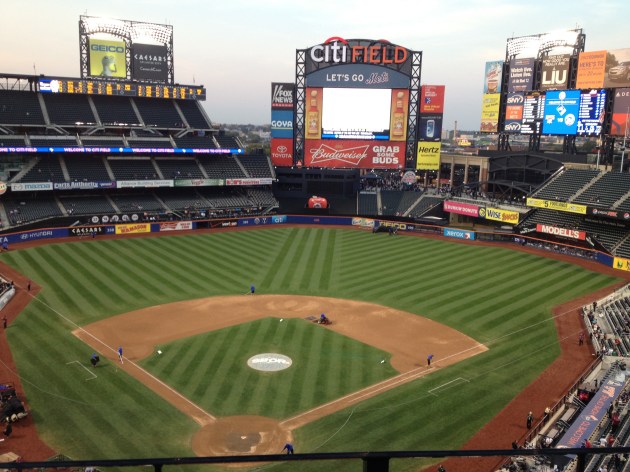
The masses gather in Queens for September baseball.

It was one of the better seats I’ve had for a ball game, especially at Citi. It featured an unblocked view from behind home plate and a great perspective for wherever the ball could be sprayed. I glanced around my section once I sat down. It looked like the auditorium in last five minutes of a middle school talent show. A few people here, a family over there, but mostly emptiness.

That’s when I spotted the first Pirates gear other than mine. A few rows to my right sat a middle-aged man wearing a Salomon Torres jersey, No. 16, circa 2007. If you don’t remember who Torres is, that’s OK, neither does Sammy Sosa.

You can instantly tell a lot about a fan just by the jersey they’re wearing. Torres was a decent player for the Pirates, but still rather forgettable. In six years in the Steel City, he went 26-28 with a 3.63 ERA and 29 saves. So when you see a guy wearing his jersey five years later, you know he’s probably a devoted fan (not to mention the fact he was at that game in particular).

I felt the need to connect with the Torres adorer so I walked over to his seat started up a conversation. As it turns out, he was just the type of fan I suspected.

I believe three types of Pirates fans exist:

  1. Those who were Pirates fans, but not anymore.
  2. Those who are technically Pirates fans, but seem constantly annoyed by the Pirates and tend to be pessimistic, regardless if the Buccos are winning or not. You’ll find a lot of overlap with this group and those affectionately known as Yinzers.
  3. Those who are Pirates fans, always were and always will be. They are the rarest of the three categories. They don’t seem to mind losing, but certainly would love to see the team win. They’ll stick with the team regardless what happens. These are the true Pirates fans.

I was lucky because my new friend was a Class 3 Pirates fan.

“I’m not optimistic the Pirates will be good any time soon, but I’m optimistic I’ll always be a Pirates fan. I absolutely love this team,” he told me. “They could be terrible for 50 more years and I’d still love ‘em.

He was from West Virginia, but lived on the South Side of Pittsburgh for 10 years. When he lived in the Burgh, he attended 30-40 games a year, usually sporting one of the jerseys of his three favorite Pirates: Franquelis Osaria, Torres and Brian Giles. He told me he moved to New York two years ago and has missed only one Pirates game in Queens since.

When I asked him why he was such a devoted fan and why he came out to such a bad series with the Mets, he referenced the Pirates as lovable losers.

“They’re just so bad, you can probably meet them,” he joked. “And going to these games is cheaper than a movie and twice as fun.”

Ahhh, a baseball purist that found himself caught in the Pirates’ tangled web. Always brings a tear to my eye.

After our brief conversation, we gave each other one last “Go Bucs” and I headed back to my seat.

The game was entertaining in spurts, but also mind-numbingly long. I didn’t leave the stadium until well after 10:30. Total game time: 3 hours 26 minutes. Both teams used a combined 12 pitchers. Managers from both teams argued several calls throughout the game. There were nine coach’s visits to the mound. There were two injury delays. There were 7,342 foul balls. It just went on and on and by the time the fourth inning rolled around, the temperature had dropped about 20 degrees and it was football weather. After the final pitch of the game, the scoreboard reflected a football score – Pirates 10, Mets 6.

All and all, it was still a fun experience but mostly because the Pirates ended up on top. The win put them in a better position to finish the season with a winning record, but it reflected the most possible season outcome: a 20th year of futility. Starting pitcher Wandy Rodriguez threw well for five of his six innings, but he gave up a first inning two-run homer. And once he ran out of steam and was taken out after the sixth, reliever Chris Resop gave up three runs on two hits and walked one AND WAS IN FOR ONLY 1/3 OF AN INNING.

The Pirates committed one error while the Mets committed two. The pitching on both sides was weak and the game was sloppy. Total attendance was 25,286 but I’ll never believe there were that many people there. Everything about the game was exactly what I expected.

I arrived home around midnight, tired, cold and numb. I’ve had worse baseball experiences, but I’ve had a lot better. If the Pirates had lost, I’d still be cursing.

Game 2 (Game 3 of the Pirates vs. Mets series at Citi Field) Wed, 09/26/2012, 7:10 p.m.

 My excursion for Game 2 began the same way as Game 1: jersey on, subway to Citi. Once I got there, I noticed an immediate difference. There were a lot more Pirates fans. Even though I was 40 minutes early, I saw exponentially more Buccos hats and jerseys than the night before. This game was the same time and on a week night, just like the previous night. But it was the night following a victory. There was still a little bit of optimism left in Pirates Nation and the atmosphere was palpable. There were even a few “let’s go Bucs” chants that faintly echoed through the stadium.

Because of this optimism, the Pirates had one of their worst games of the season and lost in unspectacular fashion, because that’s what happens when the universe realizes Pirates fans have hope. Final score: Mets 6, Pirates 0. The Pirates managed only three hits, two of which of which came off the bat of Pedro Alvarez. Pittsburgh committed an error and never stood a chance. Mets pitcher Jeremy Hefner (2-7 before that game) looked like a super-star, striking out seven and walking only one.

What could make a game like this even worse? Keeping a detailed scorebook, of course. I predicted that I would enjoy keeping score during the game more than just sitting back and watching. After all, I consider myself a stat guy and always found it fun to look back on the numbers and know exactly what happened. I’m a baseball nerd at heart. But unfortunately, I’m also a Pirates fan. And let me tell you, the only thing more wrenching than witnessing your team get kicked around the diamond is meticulously charting it as it happens.

On the Pirates side of my score sheet, I got to connect first and second base ONCE (almost twice, but I had to stop the line halfway because Starling Marte got caught stealing). I drew eight Ks (three of them backwards). I ran out of boxes to put Pirates pitchers in (they finished the game with five).

There were two redeeming factors to this game. The first was the temperature. It was a mild 72 degrees – perfect baseball weather. And just as I had feared during the first night, the Pirates ruined it. The second bright spot had nothing to do with the Pirates. It was in fact, on the Mets side of my scorecard. In the “notes” section, I wrote “1,419 all-time hits for David Wright, most in Mets history.” It wasn’t a huge deal for me, personally. I’m not against David Wright, but I couldn’t care less about how many hits he has or will ever get. I wasn’t happy that he got the record-tying and record-breaking hits against the Pirates. But I couldn’t help but smile when No. 1,219 dribbled through the infield.

Since I moved to New York, I’ve always had an affinity for the Mets. I decided that since I was living in a new city, I would pick a baseball team to follow (but not necessarily root for). I’d always been a hater of the Evil Empire so that left me with the Mets. I found that they were a lot like the Pirates. Sure, the payroll was a lot higher, but they would win a little and ultimately collapse. They were the Pirates in pinstripes. They were the North Shore in Queens. They were lovable losers. So when I saw everyone in the stadium rise to their feet to give Wright a standing ovation, both during and after the game, I was happy that the Mets had accomplished something this season. Just like the previous game when the Mets fans felt bad for me and the Pirates won, I felt sorry for the Mets fans and their team won.

Want to dig lower than rock bottom? Have a Pirates fan feel sorry for you.

Final Conclusions

After my two-day solo set with the Mets and the Pirates, I learned a few things.

  • If a game is between two natural-born losers, it’s probably better to watch it with a buddy. There are far too many times during games like that when you want to turn to the person next to you to say, “Wow, that was just awful, these guys actually get paid to play baseball?” Saying that to a stranger who is rooting for the opposing team won’t get you far in the making friends department. There are certainly positives to sitting by yourself, alone with your thoughts and observations, but I feel those times are best reserved for the middle of the wilderness on a rainy day.
  •  Above all else, I want my team to win. Sure, I’ve been rooting for a losing team for 19 years, but I’ve never gotten used to losing. The weather was nicer on the second night and the game was much quicker, but there was no comparison to how much fun I had the first night. Even though I felt very little pride after the win on the first night (a Mets fan told me, “Raise the Jolly Roger” after the game and I replied, “for what it’s worth.”), it was at least something that felt like pride. The second game left me ashamed the way a parent is ashamed when a child gets caught shoplifting. I just want them to do better so people think better of them and myself and so we can all have a more positive existence. If I just became numb to their losing ways, I wouldn’t feel anything when they won. And when it comes down to it, winning feels so much better because I know how much losing hurts.
  •  A night out at the ball park always has inherent value, even if you’re alone, your team is losing and hardly anyone else is in the stadium. Going to a baseball game is simple and refreshing. Ever since I moved to the city, I’ve been surrounded by grey concrete and dirty sidewalks. There’s no grass and few trees. There is no open space. But when you exit the concourse into the seating area at the ball park, the green of the grass and the red of the dirt and the immaculate white bases offer a refreshing view that few other places in the city can. There’s a feeling of good, clean innocence. It’s nine men wearing gloves and ball caps trying to catch a ball. It’s simple and it’s like a spa for the sports fan’s senses. It’s about buying an overpriced hotdog and beer because it feels right at a ball game, and possibly nowhere else. It’s a throwback to my childhood, which were fun and simpler times.
  •  Even though my team sucks and so do the Mets, watching them suck in person is far more enjoyable than watching them suck on television. To hear the organ, smell the food and sing “Take Me Out to the Ball Game,” lessons the blow of such bad baseball. The fan experience is underrated in this regard, because there is such tradition associated with baseball. Football might be more popular in America, but there’s no game more deeply rooted in the tradition of our country than baseball. Ask Ken Burns.
  •  Being a Pirates fan still isn’t easy and it probably won’t be for a long time. The Pirates need sustainable pitching. They need better minor league development so they can bring more players like Andrew McCutchen up through the system and make an impact at the big league level. Rod Barajas and Clint Barmes are terrible and are just the latest in a long line of poor free-agent off-season acquisitions.
  •  The Pirates need to get better and so do the Mets. Fans have been waiting awhile for these teams to be good again. All fans, except for Browns fans and Flyers fans have that right. And if they don’t get better? Damn it, I’ll still be there. If I’m still living in New York City when next May rolls around, I’ll be clearing my schedule on the 9th, 10th, 11th and 12th.

Because my name is Pete and the most important thing I learned was that I’m a Class 3 Pirates fan.

Kyle Stark Raving Mad

So when I posted my last blog entry last night entitled “How Clueless is Pirates Assistant GM Kyle Stark?” I didn’t think that my opinion of the Pirates assistant GM could get much lower. I noted that he had been obnoxious and disrespectful to two former Pirates players who approached him about jobs within the organization, one of which had helped the Pirates win at least one World Series. This offended me as a Pirates fan, a baseball fan in general and as a decent human being who will always show respect to my elders.

But just like I should stop being surprised that the Pirates keep having losing seasons and employing people like Kyle Stark, I should probably stop being surprised that Kyle Stark continues to come off even more as an ignorant lunatic.

Late last night, Pittsburgh Tribune-Review columnist Dejan Kovacevic posted on his blog the next clue into Stark’s strange and disconcerting journey down the rabbit hole (and his attempt to drag the Pirates minor league system with him). Kovacevic explained in his Friday column that it was an email sent by Stark on June 28 to his minor league managers and coaches (Pirates GM Neil Huntington was copied on the email; Pirates principal owner Bob Nutting and president Frank Coonelly were not).

The following is the email from Kovacevic’s blog and my analysis/response to Mr. Stark (my comments in bold):

From: Stark, Kyle

Sent: Thursday, June 28, 2012 5:22 PM

Subject: SECOND HALF – OUR WHAT

So what do we need to get done in the second half?

Over the last four days, we’ve reconnected with our WHY — turning boys into men so that we can re-bond a city with a baseball team and change the world through baseball.

Turning boys into men isn’t really the goal here, it’s pretty much to turn young men into competent baseball players who can eventually contribute at the big league level, which is especially important because there’s a lot of baseball yet to play and the major leaguers who are already up with the club are bound to get tired in a month or two. Remember that epic collapse last season? Yeah, it happened around the end of July and we should try to solidify the team’s depth with some confident youngsters to make sure that doesn’t happen again this year. I’ll give you credit for stressing that the team needs to re-bond with city, but it might be saying a bit much to “change the world through baseball.” Let’s just try to change the team with a winning season and go from there.

We’ve refocused and clarified our HOW — relentless, systematic and cohesive. All of these discussions have been tied to the ‘one thing’ that we need to move forward in the second half – we’ve trained them up, now we need to help them trust it and transfer it on the field. 

You say you’ve trained them up, but you better make sure that they don’t need some further training. In fact, they should probably just keep training for the rest of the season because that’s sort of what ball players do. They keep working on getting better and they never stop striving to be better. A few extra grounders and some time in the cage couldn’t hurt…

Which brings us to our WHAT …

As we talk about turning boys into men and developing them as PROs, this requires a few key characteristics. Those characteristics match our PRO values and are vividly captured by Bernie’s story about Olympic thrower Mac Wilkins and his views on what makes an Olympic champion. Mac explained that gold medal winners live by three golden rules — Dream and be creative like a Hippie. Have the discipline and perseverance of a Boy Scout. Be crazy and take risks like the Hells Angels. …

Woah, hang on a second. Those sound like three types of people who have very little to do with each other. And if I’m being honest, I don’t think any one person should possess all of those characteristics. In fact, if I had to come up with a single person that does, it would definitely be this guy…

Kyle Stark’s ideal professional baseball player.

1. Dream like a Hippie — PASSION — Elite people have big dreams, are driven by those dreams, and believe that they can achieve them.

Yes, and hippies take acid, dance around in the mud and listen to Hendrix. Then, they climb to the roof and jump off because the believe they can fly.

2. Prepare like a Boy Scout — RELENTLESS — Elite people have extreme work ethic, train exhaustively to get better, and prepare fully so they can be their best when their best is needed.

Spot on, Kyle. If this was your only suggestion in the email, I’d say the Pirates farm system will be doing quite well with its development by September.

3. Trust like a Hell’s Angel — OWNERSHIP — Elite people trust their preparation, own their strengths and weaknesses, know what they do best and build conviction around it, and compete with reckless abandon.

Well, I agree with you that trust is important and ownership is key, but let’s take a step back with the Hell’s Angels stuff. It’s probably not the best group of people to strive to be…

The biggest impact we can have in the second half is developing more Hell’s Angels.

Of course! Wait, what?

Well, now that I have given it literally no thought, drank some varnish and closed the car door on my head numerous times, this is starting to sound like a pretty solid idea.

We are really good at working before games. We excel at developing Boy Scouts. However, men play in the Big Leagues and that requires the reckless abandon of a Hell’s Angel. 

Exactly. Because when I see successful teams like the Yankees, Reds, Nationals, etc., it always seems like they just don’t give a damn. In fact, last night I saw Robinson Cano field a grounder and intentionally beam the runner with the ball right in the head. Then he stuck his hat down his pants and tackled the home plate umpire. And then, the Nats announced they were going to keep Steven Strasburg in for about 250 (give or take) pitches every game because the best medicine for a surgically repaired elbow is reckless abandon.

This is a mentality that is developed. It is a harder mentality to develop with less control, more gray area, and less science.  However, it is the separation between good coaches and great ones, good development systems and great ones, and good organizations and great ones.  Training guys to unleash what they’ve got is an art and needs to be our WHAT in the second half.

As you do some research on the Hell’s Angels, you come across three main qualities that set them apart and symbolize their mystique:

I’m going to guess 1. Their propensity for brutal violence — including homicide — against other gangs as well as innocent bystanders. 2. Their willingness to engage in drug-and-alcohol-fueled crime sprees. 3. And oh, I don’t know, their U.S. Department of Justice given status as an organized crime syndicate and public perception as some of the scariest people on motorcycles you’d never want to encounter in your life.

1. Swagger — There is an extreme confidence in themselves, their brothers, and what they’re about. They carry a chip on their shoulder and dare others to knock it off. They have an edge. Do our players have an edge? Do we have an edge? What are we doing to develop that edge?

The Pirates haven’t had a winning season in 19 years. That should qualify as a big enough chip on their shoulders. But I guess if you really wanted to piss them off and lose focus on playing baseball you could have Navy SEALs come to camp and put them through a rigorous training regimen that even common military personnel would find taxing. That ought to make men out of them!

2. Reckless abandon — Not only do they have an edge, but they live life on the edge. They’re described as free-spirited, which can be defined as somewhat irresponsible. 

So you want your players to be somewhat irresponsible? Well I guess the Red Sox did get a TON of good media last year after they started being irresponsible in the locker room. I like where your head’s at Kyle…

They risk. They have no fear. They have a care-free and “care-less” attitude. You could argue that on one hand they care so much about who they are and what they do, but on the other hand they could care less in some areas such as what others think of them, of potential risks, of probabilities, etc. They’re more focused on possibilities than probabilities. They’re not consumed or swayed by what others think. They sell out to their purpose and live life fully and in-the-moment (“this pitch”). There has actually been a leadership book written about this approach to life, i.e. living life, experiencing it, and learning from your experiences. 

I bet it’s entitled “The Hell’s Angels: Why Modern Day Politics and Sports Would Benefit From Their In-Your-Face-Style” By Chuck Manson.

Their name comes from World War II fighting squadrons known for their extraordinary and dangerous feats of aviation. Do our players play with reckless abandon? Do we have reckless abandon? What are we doing to develop this mentality?

Well, I suppose we could bring in some Navy SEALs and…oh, already suggested that. I guess we could make them all fly fighter jets and shoot at each other? (And as far as the major league club goes, signing Clint Barmes, Rod Barajas and Nate McLouth in the off-season should count as reckless abandon, right?)

3. Bound by brotherhood — At the end of the day, they are fiercely loyal to each other. It is about the group and the bonds that exist between members. They can fight with each other, but someone external better not say anything negative about them. They love each other. Are our players bound by brotherhood? Are we bound by brotherhood? What are we doing to develop this bond?

That settles it. All players from every minor league team and managers too, grab a knife, cut your hand and shake on it. We’re gonna be blood brothers!

As the calendar turns to July, we are selling out and committing to this approach. We’ve trained them. We need to train their trust now. Our focus should be on developing Hell’s Angels. That requires …

Or you could teach them how to bunt, steal bases, turn double plays correctly and be mindful to know the situation while on defense and offense. Ahhhh, no, you know what? You’re right, that’s what all the other teams do. We need to be different. And…not good…at baseball.

– Building confidence (helping players know what they do well, perfecting those traits so we’re not just working on weaknesses, speaking greatness into them, etc.)

But working on weaknesses would probably be a good idea too. You know, so they aren’t so bad at basic fundamentals. Did I mention bunting?

– Encouraging risk (pushing players beyond their comfort zones, putting them in risky situations, viewing the risk as success rather than its result, celebrating risk taking, etc.)

Damn straight! Who says we can’t all try to stretch singles into triples? Bollocks to the system, let’s skip practice and go base jumping!

– Going alongside them (being a ‘guide on the side’ rather than a ‘sage on the stage,’ asking questions rather than giving answers, celebrating aggressive failure and the lessons that come from it, etc.)

– Adding chaos and intensity to our training (get them out of their comfort zone, add stress, add competition to the work day, etc.)

Yes, the more stress the better. Because I know for a fact that scientists and doctors have no idea if stress can negatively impact a person’s health or not. Whatever doesn’t kill ya only makes you stronger, right Mr. Stark? Besides, playing anywhere from 135-144 games over the course of a summer to try to earn a promotion to the majors while staying healthy and keeping their numbers high enough to avoid a demotion probably isn’t stressful enough. I know, let’s light their gloves on fire and hold their families hostage during games! That should really get them out of their comfort zone!

– Preparing them to compete rather than training all the time (get the focus on the competition, shift our purpose to preparation rather than working a physical technique, outward focus rather than inward, etc.)

But what if they don’t know the physical techniques yet? Yeah, you’re right. They could probably find some Tom Emanski videos on YouTube in their spare time anyway.

– Getting them outside of themselves and into the team (care about someone else, take care of each other, have each other’s back, etc.)

Yeah they definitely gotta have each other’s backs, just in case a rival motorcycle gang rides into town and tries to take their turf!

For this to happen, we must get out of our comfort zones and flex our own Hell’s Angel muscle. We must be extreme in our commitment to these ideas. This is ultimately about developing a mentality and a culture where this becomes our identity. A culture of risk and less control is unsettling for us control freaks! 

…and successful baseball clubs, but go on…

However, it is the answer to letting skill out and WHAT we need to do in the second half.

LB and Bernie will be following up with more details as we move forward. Sell out and commit to this. Coach with swagger, reckless abandon, and bounded by brotherhood and we’ll see those same traits in our players.

HOKA HEY — It’s a good day to die!!!

Yes, I’d say we’re all about ready to commit suicide after that. Thanks for the pep talk Mr. Stark.

Pirates Recent Skid: Who’s to Blame?

I was 5 years old the last time the Pittsburgh Pirates made the playoffs. What’s more, that was also the last time the team had a winning season. It would make the franchise look pretty bad if I were 12 right now.  Eight-straight losing seasons would be rough. It would make it look eyebrow-raisingly bad if I were 18. Fourteen-straight losing seasons would be downright awful.

But alas, I am 24 and if you do the math correctly, that means the Pirates have not played more than 162 games in a season or finished with a winning record in 19 years. That, my friends, is indescribably bad.

The last time the Pirates were winners, gas cost $1.13 per gallon, everyone started buying Discmans and some kids who are in college now weren’t even born yet.

But 2012 has been a beacon of hope for the Pirates and their fans. Through the first half of this season, all signs have pointed in a positive direction. Although they were only 10-12 in April, the following months transformed them. In May they went 15-13. In June, they went 17-10. In July, they went 17-9. Winning was no longer the exception, it was the rule.

The Buccos spent long stretches in first place in the NL Central and on July 28, they were 16 games over 500. They were officially a playoff contender and even the pundits on ESPN’s Baseball Tonight would talk about the Pirates’ success every night (after they discussed the Yankees of course).

Lately, things haven’t looked as bright. August has begun to look like April. So far this month, the Pirates have gone 5-8 and have been outscored 71-59. In their last 10 games, the Pirates are 4-6. In their last 16, they are 6-10. In their last six series, they’ve won one, split one and lost four.

But what is making Pirates fans panic most lately is last night’s debacle against the Dodgers. The Pirates suffered their worst loss of the season, giving up 11 runs and failing to score. They committed two errors (and a third should have been counted when Pedro Alvarez let a line-drive deflect out of his glove), were 0-7 with runners in scoring position and stranded six. It was a U-G-L-Y game and one that fans won’t forget any time soon.

That loss put Pittsburgh six games back of first-place Cincinnati in the NL Central and they’re now clinging to a half-game lead on Los Angeles and San Francisco for the second wild card spot in the NL. If they lose again to the Dodgers tonight, they could be out of a playoff spot for the first time since July 1.

So who or what is to blame for this recent fall from grace?

Although there is no one definitive factor that has made the Pirates drop off a bit lately, there are a few things to consider.

And to be perfectly clear, the fans in the Steel City shouldn’t panic yet. There are still 46 games left to play and the team is still in a wild card spot. There’s way too much baseball left to make any predictions one way or the other.

 The first thing you might notice is how the Pirates pitching staff has struggled recently. In the last eight days, the Pirates have the worst ERA in baseball (6.25).*In those eight games, the Pirates went 2-6 while giving up 57 runs (50 of them earned).

*In that eight-day span, not all Major League teams played eight games.

James McDonald, who was considered Pittsburgh’s ace in the first half, has been the biggest underachieving starter lately. Dating back to July 2, he has gone 3-5 and his ERA has jumped from 2.45 to 3.77. His last four games have been some of the worst of his season. In those four, he averaged 5.2 innings per game while averaging a whopping 95.5 pitches per game. In the month of August, J-Mac has notched an ERA of 8.71.

The Pirates are currently using a six-man rotation but plan on returning to a five-man rotation on August 23, their next scheduled day off. If McDonald doesn’t improve quickly, he could be swapped from the rotation in favor of someone else and I wouldn’t argue against it.

From an offensive standpoint, the Pirates still leave something to be desired. They have the 22nd-best team batting average in the majors (.246) and the 12th-best in the NL. They rank 20th in runs scored in the majors (482) and 10th in the NL. Pittsburgh is also 22nd in league-wide OPS (.709) while ranking 11th in the NL. They still rank 10th in the majors in home runs (130) but it’s clear that the team isn’t hitting well enough.

The biggest plate struggles have come from catcher Rod Barajas and shortstop Clint Barmes. Barajas is hitting .194 and Barmes is hitting .213. Barmes is actually swinging a better than we was earlier in the season. In March/April, he hit .149 and in May he hit .189.

Both players are every-day starters and they shouldn’t be, especially for their 2012 price tags. Barmes and Barajas are the two highest paid non-pitchers on the team, with Barmes making $5 million this year and Barajas pulling in $4 million in 2012.

The Pirates might not have the most viable option to replace Barmes on a more consistent basis. Rookie Jordy Mercer hasn’t proven himself yet (he’s played in only 20 games) but he might be worth a look in the middle of a pennant race because of Barmes’ lumber ineptitude.

Barajas on the other hand, has a legitimate replacement backing him up every day. Michael McKenry, a three-year veteran, is hitting .283 and is only starting once every few days. In June, July and August, he is hitting .306, .325 and .360, respectively. The Fort, as he is affectionately referred to in Pittsburgh, has been an exciting young talent to watch this season and has only garnered 152 at bats compared to Barajas’ 242. If Pirates manager Clint Hurdle wants to improve a struggling lineup at the plate, McKenry should be the every-day guy until he shows that he shouldn’t be.

That brings me to Andrew McCutchen. It’s tremendously difficult to type a bad word about the guy. He’s been sensational for the Buccos this year, by far the team MVP. He has led the majors in batting average basically all season and he’s a legitimate threat for NL MVP. But I need to cite the fact that he hasn’t quite been the same player since August came along. After hitting .370 in June and .446 in July, McCutchen entered yesterday’s game hitting .289 with a .377 on-base percentage in August. That’s still a better average than all but a few of the Pirates regulars. He has also hit only one home run in August. Don’t get me wrong, he’s still leading the majors with a .359 batting average and that’s really impressive. I no, we shouldn’t expect him to keep hitting .370. But he had a similar cool down last season in the final months and it seems that the Pirates go as Cutch goes. And if the rest of the team is going to continue to bad average as a whole, he needs to keep swinging an unbelievable bat for the Pirates to win consistently. It’s a huge burden on his shoulders, but he’s a star and stars need to help carry a faltering team. If Pittsburgh wants to stay in the playoff picture, McCutchen needs to level off his falling numbers and get back to consistency.

With all of that said, I feel it’s important to note some reasons that fans cannot blame for the Pirates’ recent misfortunes.

  • A single perceived turning point like last season. Although there were a number of factors that led to the demise of the 2011 season, many fans will point to the “Jerry Meals incident” as the turning point for the Pirates. After 19 innings, the Buccos lost a game against the Atlanta Braves on a clearly blown call by home plate umpire Meals. After that night, the Pirates seemed deflated and finished the season 72-90. So far this year, you can’t really pinpoint a single game that has struck a significant blow to the Pirates. Hopefully, the 11-0 trouncing from the Dodgers last night won’t solidify as a favorite for a downfall.
  • Injuries. This has been a healthy season for the Pirates. Up to last night, they have had the fewest disabled list assignments in the National League and were tied for the fewest in the Major Leagues. They have had only nine of such assignments this season, followed by the Reds (10), Marlins (10) and Brewers (10).
  • A difficult second-half schedule. After the all-star break, the Pirates’ second half was regarded as one of the easiest in all of baseball (ESPN’s Buster Olney says they have the second easiest behind only the Reds). At the break, Pittsburgh’s remaining opponents had a .459 winning percentage and included lowly teams like the Brewers (52-63)*, Cubs (45-70)*, Astros (39-79)*, Rockies (43-71)* and Padres (52-66)*. And if their weak opposition wasn’t enough, more than half of their remaining games would be at home. To date, the Pirates are tied for the second best home record in the majors (36-22).*

 *Reflects current record.

  • The number of errors. What used to be a telling stat of futility for the Pirates is now one of relative success. Through 116 games, the Pirates have committed 71 errors. That doesn’t make them an elite fielding team, but it’s good enough to rank them sixth in the NL and 12th overall in the majors. The standouts have been Neil Walker (fifth among NL second baseman with six), Barmes (tied for second among NL shortstops with 11) and McCutchen (tied for first among NL center fielders with one).
  • Joel Hanrahan. The Hammer has still been a hummer this season. Although the starting rotation has struggled a bit lately and the bullpen hasn’t been what it was in the first half, Hanrahan has been as consistent as ever throughout the season. His velocity has been down and he hasn’t had the control he’d like, but Hanrahan still has the third-most saves in the majors this season (33), behind only Tampa Bay’s Fernando Rodney (37) and Baltimore’s Jim Johnson (34). The Pirate’s closer has blown only three saves this season and hasn’t blown one since July 3 (an 8-7 win against the Astros in which Hanrahan was awarded the win).

You may choose to agree or disagree on any of my points, (there are certainly some areas I didn’t have time to address like the Pirates’ recent trades, Pedro Alvarez constantly striking out (he has had 37 multi-strike out games out of 105 played — 35.2 percent), A.J. Burnett continuing to be a stud) but if you’re a Pirates fan, choose to keep rooting for the Buccos. Because you never know the next time they’ll be in line for a post season appearance. And just for good measure, you might want to note that today, gas costs $3.70 a gallon, everyone is buying iPhone 5s and college kids are currently witnessing a winning Pittsburgh Pirates ball club.

Emotion Ties All Olympic Athletes, Viewers Together

When the opening ceremonies of the Olympics got underway on Friday night, I couldn’t help but feel an overwhelming amount of anticipation for the days to follow. As an invested sports fan and writer, there’s nothing better than having something to watch, non-stop, for 17 straight days.

Like most proud Americans, I enjoy watching the events in which the United States is favored – swimming, women’s gymnastics, and men’s basketball to name a few – but in the end, I want to watch everything.  Because regardless of their popularity, every Olympic athlete deserves our attention.

It’s been only four days since the massive Olympic cauldron was lit in London and I’ve already watched handball, basketball, swimming, archery, diving, table tennis, equestrian, shooting, fencing, water polo, badminton, volleyball, beach volleyball, boxing, soccer, gymnastics, rowing, tennis, weight lifting and who could forget, white-water canoeing slalom.

Outside of Olympic competition, I routinely watch three of the above-mentioned sports (basketball, boxing and tennis). But that’s one reason I love the Games so much. It’s not only the coverage of popular and mainstream sports, it’s also the display of the obscure athletes that shine on a world-wide stage only once every four years. Little known athletes and world-wide superstars share common ground here.

The Olympics is the great equalizer.

As much as I enjoy watching familiar faces at the Games, I take equal satisfaction in watching the performances of the unrecognizable athletes who may never again have a chance to be in the lime light. These are the skeet shooters, table tennis players and kayakers who train every day of their lives for one moment in the sun, to represent their country and show the world that just because you never heard of them doesn’t mean they aren’t important.

From a monetary standpoint, it’s clear that one sport doesn’t mean more than another in the Olympics. The worth of a 2012 Olympic gold medal for the 10 meter air pistol event is equal to the worth of a men’s basketball gold medal – about $644. And using the United States Olympic Committee medal bonuses as an example, the amounts of $25,000 for gold, $15,000 for silver and $10,000 for bronze applies to the full gamut of U.S. athletes, regardless of sport.

But more importantly, all Olympic athletes share the pride of representing their country and the backing of their country’s citizens. And when it comes to emotion, the Games provide a level ground from which athletes of all sports fall or ascend from.

When U.S. gymnast Jordyn Wieber fell just short of qualifying for the individual all-around final on Sunday, you could see and feel her devastation. She said “it was a little bit of a disappointment” but the hollow longing in her eyes was palpable. It was more than slight disappointment.

It was agony.

This was the event that she was supposed to own. She knew it and the rest of the world did, too. Weiber was the reigning all-around champion and was heavily favored to win the event, but a wobble on the balance beam and a slight step out of bounds during the floor event dropped her to third place behind fellow Americans Aly Raisman and Gabby Douglas. Because a rule states only two members of a country’s team can move onto the final 24, Weiber could not advance. As the U.S. team exited the arena and started doing interviews, Douglas beamed her trademark smile from ear to ear. Raisman cried tears of joy. Wieber wept to the contrary.

It made for terrific television from both an entertainment standpoint and that of identifiable human emotion. It felt very human to experience the conflict the team was going through. Sure, the American group was pleased that two of its members made the final, but at the same time, the team shared the emotional burden of Wieber’s uncanny shortfall.

I found myself identifying just as much with the emotions of German fencer Britta Heidemann when she lost the gold medal in overtime of the women’s individual epee event on Monday. Although this event received next to no press attention, Heidemann was the defending Olympic champion in the event, winning gold in Beijing in 2008, and that made her one of the favorites to bring home the gold again from London.

Admittedly, I know very little about fencing and even less about the specific Olympic events within it. But I didn’t need to know anything about the sport to realize how much it hurt Heidemann to lose gold in OT.

After coming from behind to force a sudden death stage, it seemed like Heidemann held the momentum advantage. But as she aggressively advanced and struck toward her foe, it wasn’t her weapon that touched first. Green lights lit up on the stage, a visible sign of her demise.

After exchanging gracious kisses on the cheek with her opponent Yana Shemyakina of the Ukraine, Heidemann quickly paced into the shadows of the arena, away from the searching cameras. There wasn’t much time to examine the expression on her face, but a split second was all it took to recognize her despondency.

Britta Heidemann moments after her gold medal defeat. (Screenshot from NBC)

In contrast, Shemyakina tore her mask off in celebration after landing the winning blow. A deep and joyful embrace of her coach was followed by her acknowledgment of the roaring crowd, while she wrapped herself in the blue and yellow Ukrainian flag.

Heidemann displayed a smile during the award ceremony; after all, she earned a silver medal for her efforts. But you have to think that it was something of a mask, covering up the disappointment of being within one strike of winning back-to-back golds.

That’s what made it fascinating. How did she really feel after losing the gold, but still achieving silver? Were her emotions of disappointment greater than those of achievement, despite the grin?


The human element made it great, not the pure sporting perspective.

It is these moments of indescribable joy and unthinkable disappointment that make the Olympics so captivating. Whether they are the most famous athletes in the world or the least known competitors of little-talked about sports, they encapsulate the raw emotion that anyone can appreciate.

Ultimately, what links the big-time Olympic athletes, no-name Olympic athletes and average people watching on television is pride in our respective countries and the emotion generated by the drive to win Olympic hardware.

Because when our Olympians – recognizable or not – win medals, so do we.

Thank You Nicklas Lidstrom

As a 24 year old, I often think that I haven’t been around to see many of the players that dominated their sports because I feel that the true legends played and retired before I was even born.

Greats like Babe Ruth, Walter Payton, Wilt Chamberlain and Bobby Orr come to mind.

Even players who did play during my life often get put into this category since I was too young to really remember them. These are guys like Larry Bird, Joe Montana and Mike Schmidt.

And I’ll admit, there are also players like Wayne Gretzky who played well into my life that I don’t really remember because I took them for granted at the time and didn’t realize their importance to the world of sports. I really regret these instances because a player like Gretzky will probably never come along in my life time.

But I realize I can use these regrets to remind me to appreciate the greats of sports that are still playing.

That brings me to Nicklas Lidstrom.

The Detroit Red Wings announced today that there will be a scheduled a press conference tomorrow at 11 a.m., which will be attended by Lidstrom and general manager Ken Holland. It’s reasonable to assume that Lidstrom may announce his retirement from hockey.

Without a doubt Lidstrom is and will be one of the best players to ever lace up skates. The 42-year-old captain has compiled quite a list of achievements and statistics in his 20-year career. He has won four Stanley Cups, seven Norris Trophies, one Conn Smythe Trophy and was an All-Star 11 times.

The Swedish defenseman was also the first European-born NHL captain to win a Stanley Cup, which earned him a membership in the Triple Gold Club – a group of 25 players who have won an Olympic Games gold medal, a World Championship gold medal and the Stanley Cup.

Lidstrom was one of the smartest defenseman in the history of the NHL. His ability to read plays in front of him and always be in ideal position made him impossible to deal with for opposing teams. He could score, distribute the puck, kill penalties and work the power play.

He wouldn’t overwhelm you with his physical game, but he didn’t need to. He could make you turn the puck over by being in perfect position.

And when Lidstrom was on the ice, chances were a lot better that the Wings would score a goal instead of their opposition. He ranks 8th all-time in career plus/minus as a plus-450. He leads all active players in this category, as well as games played.

I could go on and on.

Now I’ll admit that I still probably didn’t watch Lidstrom play as much as I should have. I grew up a Penguins fan and my broad interest in all NHL teams and players didn’t develop until around the 2000s. For the majority of my life, I was busy watching Lemieux, Jagr and then Crosby and Malkin.

But there is one memory of Lidstrom that I will never forget. He was part of the greatest sports memory in my life to date. It was June 12, 2009. Game 7 of the 2009 Stanley Cup Finals — Penguins versus Redwings.

Neither the Pens nor the Wings had lost a game at home in the series. Pittsburgh had the momentum going into Game 7, coming off of a Game 6 home victory, but the Red Wings lost only one game at home during the entire playoffs — and it came in triple overtime.

Pittsburgh held a 2-1 lead in the final minutes of the third, but Detroit surged and put immense pressure on the Pens. With only seconds left, Detroit forward Henrik Zetterberg blasted a shot from the right circle on Pittsburgh netminder Marc-Andre Fleury. The puck deflected off of Fleury’s pads, sending it to the far left side of the ice. Lidstrom was there to receive the rebound (in perfect position as always) with the entire left side of the net gaping in front of him. He blasted a shot with two seconds remaining, only to have Fleury dive across to stop it and end the series.

Never have I transitioned from such a feeling of impending doom to pure elation so quickly. I was sure Lidstrom would bury the shot because, well, he was Nick Lidstrom. When my team was able to stop him to secure a Stanley Cup victory, it only further solidified the fact that the Penguins were the best in hockey. I don’t know if I’ll ever have a moment like that again.

So thank you Nicklas Lidstrom for coming up short just that one time. I’ll never forget your legendary status and how it made me feel that day.

If you retire tomorrow, it will be a retirement well deserved.

Penguins Fans Shouldn’t Fear Offseason Roster Changes

One look at the Penguins roster right now reveals a ton of talent and potential. But one look at the record this core of players has put together in the postseason in the past three years reveals something else: a pattern of poor play despite that overwhelming talent.

There aren’t a whole lot of Penguins fans out there that would say they’d like to see a major change to this roster, but they may not have a choice. Fans and Pens GM Ray Shero should be asking themselves the same question: Can this group of players win a Stanley Cup?

That may seem disheartening to some, mostly because the core of the team is largely unchanged from the team that raised the Cup in 2009 (13 players remain on the roster from the championship team, including Marc-Andre Fleury, Sidney Crosby, Evgeni Malkin, Jordan Staal, Brooks Orpik and Kris Letang).

But as much as Pens fans want it to stay ‘09 forever (as Pens fans previously wanted it to stay 1991 and 1992 before) they need to consider what has happened recently and how that will affect the next few years for the team, especially with the uncertainty of the upcoming collective bargaining agreement in September.

Ray Shero may have to make some difficult decisions this summer because of CBA and that could mean the departure of center Jordan Staal. Don’t get me wrong, he may be just as big a piece as Sidney Crosby and Evgeni Malkin and I believe the Penguins should do everything in their power to keep Staal. But if Shero cannot figure a way to keep all three, Staal is the odd man out.

Staal has consistently proven over the past few seasons that he is much better than the third line center role he has assumed on this team. Penguins fans undoubtedly have considered themselves blessed to have a team so solid down the middle throughout the entire lineup. But consistency and talent like that comes with a price.

Both Staal and Crosby are heading into the final year of their contracts and Malkin is heading into the next to last year of his. Both Crosby and Malkin are making $8.7 million and both could be seeking raises considering how outstanding they have been. But the same can be said about Staal, and he’s making $4.7 less than both of them. He could easily command first-line center money somewhere else and if he is thinking what’s best for him, Staal may go where he gets first-line time for more cash.

And yes, Staal has been quoted that he would love to stay in Pittsburgh, but if that stands in the way of his becoming a first line guy and making first-liner coin, he may want to consider other options. Whether he stays in Pittsburgh or not rests on Staal just as much as it does on the Penguins.

As much as Pittsburgh loves Staal and as good as he’s been for the Pens, there’s a chance he could be leaving soon. I’m not saying they should trade him, but if he’s going to be leaving once his contract expires anyway, the Pens might as well get some good value for him (which they absolutely would).

One scenario that has been brought up recently is a potential deal with the Edmonton Oilers.  Over the weekend, Dave Staples wrote a column at the Edmonton Journal that brought up the question: Should the Edmonton Oilers consider trading the No. 1 overall pick in the draft to the Pittsburgh Penguins for Staal?

The Oilers certainly would love to have a young center like Staal that can bring just as much defensive help to a team as he can offense and right now, the primary need for Edmonton is players that can help keep the puck out of their own net.

On the Penguins side, it could also make sense considering they haven’t been able to draft particularly well in the past few years because they have been in the tail end of the draft order. They have some great young talent at defense, but their depth at forward is scant when you look beyond the NHL roster. If they were to receive the No. 1 pick, they could pick up an NHL-ready player like Nail Yakupov and they wouldn’t have to worry about paying him big bucks for a few years after his rookie deal.

Right now, it’s just food for thought and speculation about a potential deal with Edmonton is just that, speculation. Edmonton has not expressed any interest in Staal whatsoever. But if Staal were to leave, regardless of where he goes, Pens fans need to be able to cope with it. Change is a part of hockey and if your team isn’t winning championships with the kind of talent Pittsburgh has, then maybe that change is necessary.

Game 19 of Remaining 29: Winnipeg at Pittsburgh

Pittsburgh Penguins: 44-21-6 (94 points)

4th in the Eastern Conference

VS.

Winnipeg Jets: 34-30-8 (76 points)

9th in the Eastern Conference

The Jets are 5-4-1 in their last 10 games and they are playing for their playoff lives. The Pens, however, are 9-0-1 in their last 10 and sit in 4th overall in the East. Pittsburgh is only three points away from the East leading Rangers and a win brings them within 1, which most people thought would be impossible. I love that motivation and I think the Pens do too. My prediction: Pens WIN.

My final 29 prediction record: 7-11

Game 13 of Remaining 29: Toronto at Pittsburgh

Pittsburgh Penguins: 39-21-5 (83 points)

4th in the Eastern Conference

VS.

Toronto Maple Leafs: 30-29-7 (67 points)

12th in the Eastern Conference

Although my predictions have gone awry lately (again), I feel like I’m going to get back on track with this prediction. So far this season, Pittsburgh has won only once in three meetings with the Leafs — which came at home. This match up is at the Consol Energy Center, so I’m confident that the Pens can take care of business in front of the home crowd. Rookie Brad Thiessen will get the start. My prediction: Pens WIN.

My final 29 prediction record: 4-8

Game 11 of Remaining 29: Pittsburgh at Colorado

Pittsburgh Penguins: 37-21-5 (79 points)

4th in the Eastern Conference

                       VS.

Colorado Avalanche: 33-28-4 (70 points)

10th in the Western Conference

So far this season, Pittsburgh has played the Avalanche only once, capturing a 6-3 victory at home in the Consol Energy Center. This matchup takes the Pens out to chilly Denver in the second game of a two-game western road trip. Pittsburgh is on a four-game winning streak while Colorado is coming off of a loss against last place Columbus. But just because the Avs were shutout by the worst team in hockey, don’t expect them to continue the poor play. I’d like the Pens to keep their streak alive, but I predicted 10 games ago that the Pens will LOSE in overtime or a shootout, garnering the team a single point.

My final 29 prediction record: 4-6